
Be honest for a moment: when was the last time you touched your own face with actual care? Not moisturiser slapped on between the alarm and the door — real, unhurried attention, the kind you give freely to everyone else.
Facial massage is worth doing. It is also one of the most oversold categories in beauty, and the gap between what gua sha genuinely does and what it is marketed as doing is enormous. There are also real contraindications that almost nobody lists — including one that matters if you have had filler or Botox recently.
A note on how we work: we have not used this particular set. What follows is based on its stated specifications and on what the research and dermatologists say about facial gua sha generally.
What Gua Sha Actually Does
Two mechanisms are real and reasonably well accepted:
- Fluid movement. Sweeping strokes encourage superficial lymphatic drainage, which genuinely reduces puffiness. If you wake up swollen and use a gua sha stone, you will look less puffy afterwards.
- Microcirculation. Friction increases surface blood flow, producing that flushed, radiant look immediately after a session.
Both are worth having. Both are also temporary — fluid redistribution, not structural change. The de-puffing effect from a single session reverses within hours, in much the same way a cold compress would.
There is a third benefit nobody measures, which is that five minutes of slow, deliberate touch is genuinely calming and releases jaw tension. That is not a small thing, and it may be the honest reason to buy one.
What It Does Not Do
The evidence base for facial gua sha is thin — not absent, but thin enough that anyone presenting it as a proven anti-ageing treatment is well ahead of the research. Specifically:
- It does not lift or sculpt in any lasting way. Claims about redefining contours are marketing rather than findings. A stone cannot move bone or reposition fat pads. Any jawline definition you see is drained fluid, and it comes back.
- It does not build collagen or erase wrinkles. Lines form from collagen loss, sun damage and repeated muscle movement. There is no robust evidence that manual massage reverses any of those.
- It does not detox anything. Your liver and kidneys handle that.
- It is not comparable to professional treatment. If genuine firmness or contour change is your goal, the things with evidence behind them are microneedling, radiofrequency and laser treatments, or injectables. Those work on tissue; gua sha works on the surface.
Those dramatic before-and-after videos are largely lighting, camera angle, time of day and water retention. Buy this for the ritual and the de-puffing, and you will be pleased. Buy it expecting a new jawline and you will not.
Who Should Not Use One
This is the section missing from almost every listing, and some of it matters more than the product itself.
- Recent filler or Botox — wait at least a month. Pressure and massage can shift product before it has settled. This one is genuinely costly to get wrong, and it is almost never mentioned alongside these tools.
- Active acne. Dragging a stone across inflamed spots spreads bacteria across your face and worsens the inflammation. Work around breakouts, or skip until they settle.
- Rosacea, couperose or visible broken capillaries. This is the one with lasting consequences. Fragile facial capillaries can be permanently broken by mechanical pressure, and permanently broken vessels generally need laser treatment to correct. If you flush easily or already have thread veins, this tool carries real risk for you.
- Blood thinners, bleeding disorders, or easy bruising. The technique deliberately stresses small capillaries. Speak to your doctor first.
- Eczema flares, psoriasis, sunburn, open wounds or any inflamed skin.
- Diabetes or circulation disorders, where healing is slower and vessels more fragile.
How to Use It Without Damaging Your Skin
Most gua sha harm comes from technique, not the tool:
- Never use it on dry skin. The stone must glide, never drag. Dry use causes microtears, redness and barrier damage. Apply a generous facial oil first — more than feels necessary.
- Use far less pressure than you think. Facial gua sha should never leave visible bruising. If you are marking your skin, you are doing damage rather than working harder. This is not body gua sha, where redness is expected.
- Hold the stone almost flat against the skin, roughly 15 to 30 degrees, and stroke upward and outward toward the ears and collarbone.
- Clean it before and after every use. A stone that lives on your vanity and touches your face daily grows bacteria. This is the most-skipped step and a common cause of unexplained breakouts.
- Two to three sessions a week is plenty if you use any real pressure. Daily is fine only if you keep it genuinely light.
- If your face is naturally lean, go shorter and lighter. The benefit here is drainage, and there is less to drain.
About the Rose Quartz
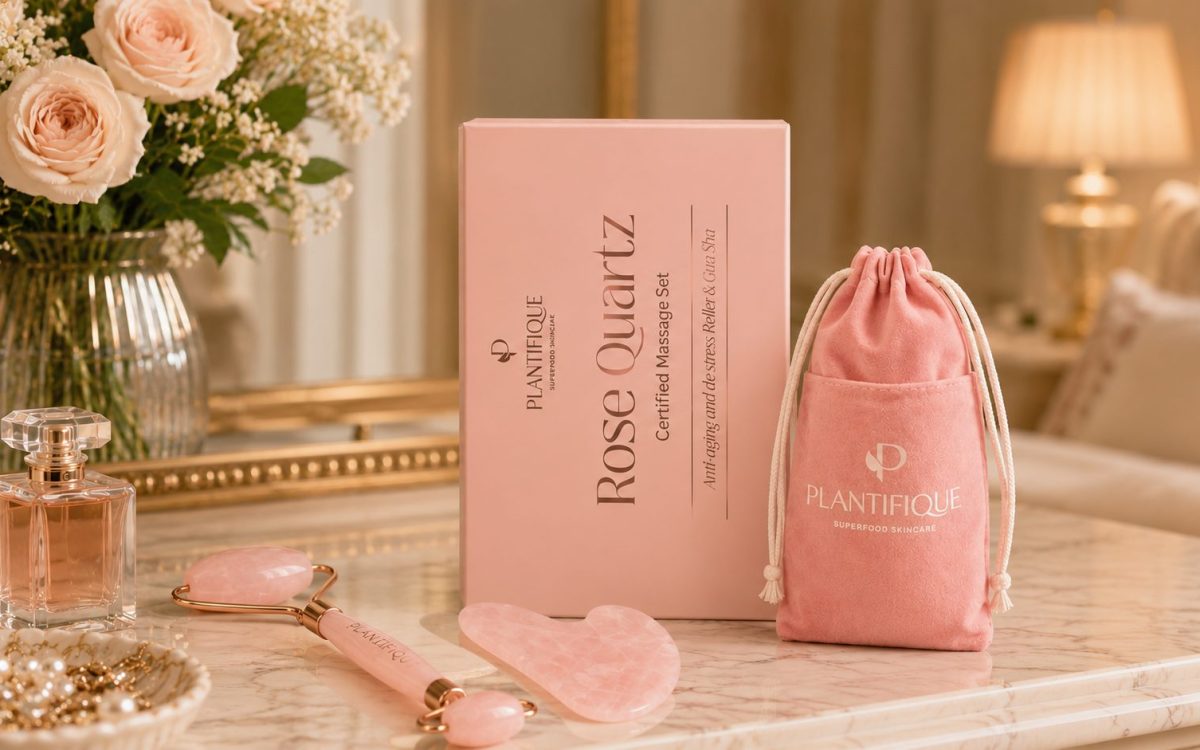
PLANTIFIQUE specify genuine rose quartz sourced from Bahia, Brazil, with rollers that pop out of the frame for cleaning — a practical detail that matters more than it sounds, since the frame is where residue collects.
Worth knowing generally: dyed glass and resin are widely sold as rose quartz in this category. Real stone has faint internal cloudiness and slight colour variation, feels heavier than expected, and stays cool. Uniform, flawless, candy-pink colouring is usually the giveaway that it is not stone.
That said, be clear about what the material buys you: rose quartz stays cool, which feels good and helps with puffiness. It has no properties beyond that. The claims about crystal energy are yours to enjoy or ignore, but they are not why the tool works.
Who It’s For
Buy it if you wake up puffy, you hold tension in your jaw, and you want a five-minute ritual that makes you slow down. On those terms it delivers, and it is inexpensive.
Skip it if you have rosacea or visible broken capillaries, active acne, or you have had injectables within the last month — or if what you actually want is lasting contour change, in which case this will disappoint you and the money is better saved toward something that works on tissue.
The pausing really is the point. It just deserves to be sold as the pausing, rather than as a jawline.
Prices and availability are accurate as of the date of publication and are subject to change. Please check the product page on Amazon for current pricing and other details.
This article is for general information and is not medical or dermatological advice. If you have a skin condition, take anticoagulant medication, or have recently had a cosmetic procedure, speak to your doctor or dermatologist before using facial massage tools.
Build the whole evening ritual with our list of luxury finds under $50.
Written by Milica Jovanović, founder of Feel Like A Goddess. I hunt down beautiful, well-made things that make everyday life feel a little more extraordinary, and I only recommend what I genuinely believe in.