
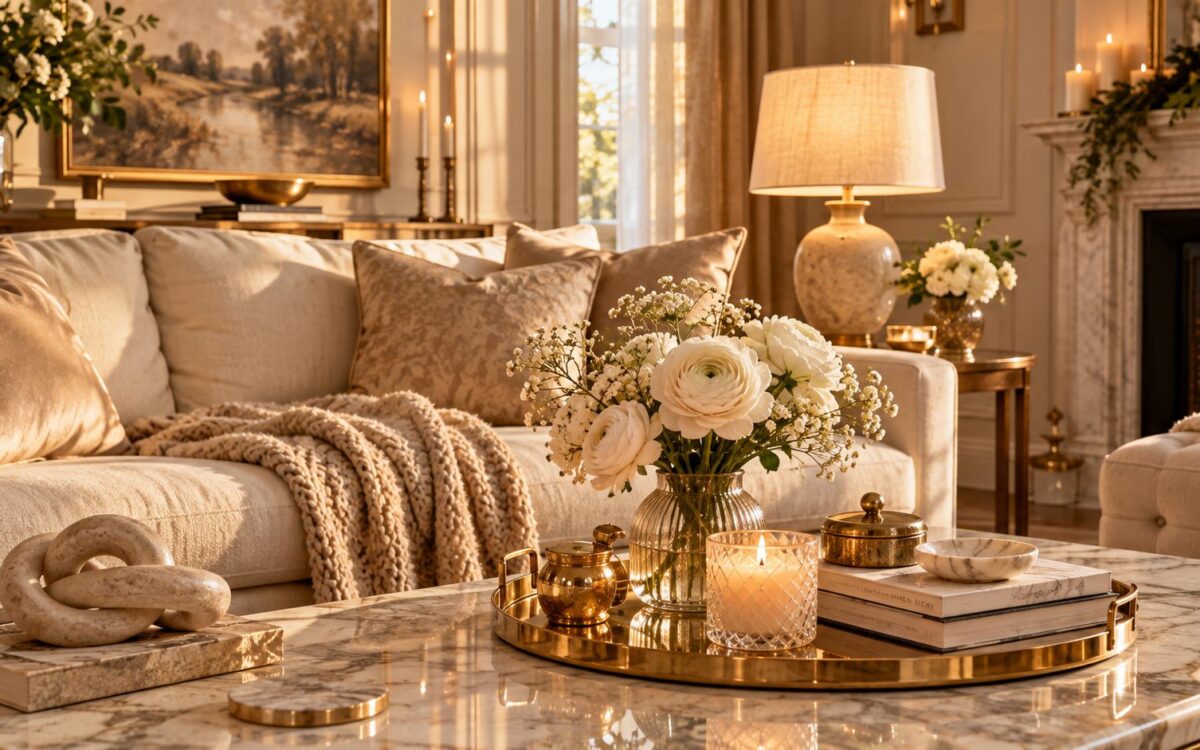
There is a particular feeling you get walking into a beautifully done home. Nothing shouts. The light is soft, the surfaces are calm, everything looks like it was chosen on purpose. You assume it cost a fortune. Most of the time, it did not.
Looking expensive at home is far less about money than people think. It is about a handful of decisions that the eye reads as wealth, quiet colours, warm light, uncluttered surfaces, and a few textures that feel good to touch. Once you know what those decisions are, you can copy them for very little. I have pulled together the twelve that make the biggest difference, roughly in the order I would tackle them, because some of these change a room in an afternoon and others are slower projects.
One thing up front. You cannot fake everything. A genuinely cheap sofa will still look cheap no matter how you style it, and no throw pillow saves it. But you can get eighty percent of the expensive look from styling and light alone, and that eighty percent is what this post is about.
1. Fix your lighting first, because it changes everything
If you do one thing on this entire list, do this one. Overhead lighting, especially the cool white bulbs most homes ship with, is the single biggest thing making your space feel like a rental. Expensive homes almost never rely on one bright ceiling light. They layer several smaller, warmer sources at different heights.
The cheapest, fastest version of this is to swap your bulbs to a warm 2700K temperature and add two or three lamps around the room, one on a side table, one in a corner, maybe one on a shelf. That warm, low, layered glow is the exact thing your brain associates with hotels and nice restaurants. A pair of simple table lamps and a set of warm bulbs is a small spend for how much it transforms a room after dark.
Do this before you buy a single decorative object, because good lighting makes everything else you own look better, and bad lighting makes even beautiful things look flat.
2. Hang your curtains high and wide
This one is almost a magic trick. Most people mount their curtain rod right at the top of the window frame, which visually chops the wall in half and makes ceilings look lower. Designers do the opposite. They mount the rod close to the ceiling and extend it several inches past the window on each side.
The effect is that your windows look taller and grander, and your curtains fall in long, uninterrupted lines. Floor length is essential here. Curtains that stop at the windowsill or, worse, hover above the floor read instantly as budget. They should just kiss the floor or pool very slightly. Simple linen or linen-look panels in a soft neutral do this beautifully and do not cost much when you buy the longer length.
3. Choose a quiet, cohesive colour palette
Walk through any expensive-looking room and count the colours. There are usually very few. Cream, greige, warm white, soft taupe, maybe one deeper accent like charcoal or olive. That restraint is a huge part of why the room feels calm and considered rather than busy and cheap.
You do not need to repaint everything, though a fresh coat of a warm neutral is one of the highest-impact budget upgrades there is. Start by pulling out the things that break your palette, the loud plastic organiser, the mismatched bright throw, the novelty mug on display, and letting the room settle into fewer, quieter tones. Cohesion reads as intention, and intention reads as money.
4. Give every surface room to breathe
Clutter is the enemy of expensive. It is also completely free to fix. Look at a styled shelf in a design magazine and you will notice most of it is empty space, with a few carefully placed objects. Look at a cluttered shelf and every inch is full.
Go through your visible surfaces, coffee table, console, kitchen counter, and take away at least half of what is on them. Group the things you keep in small clusters, usually in odd numbers, with clear space around them. A stack of two or three books, a small vase, one object with an interesting shape. That is it. The empty space is doing as much work as the objects.
5. Add a large decorative tray to anchor your surfaces
Here is a small, affordable object that punches far above its weight. A tray gathers the odds and ends on a coffee table or ottoman, a candle, a small stack of books, a little vase, and turns a scattered mess into a deliberate vignette. Gold or brass trays in particular add a warm metallic gleam that reads as luxury.
The reason it works is that it creates a defined edge. Instead of objects floating randomly across a surface, they sit inside a frame, and framing signals care. This is one of the cheapest, most reliable expensive-home tricks going.
6. Bring in warm metallics, sparingly
A little gold, brass, or antique bronze goes a long way. Think a picture frame, drawer pulls, the tray above, the base of a lamp, a small bowl. These warm metals catch the light and add a sense of richness that flat, matte surfaces lack.
The key word is sparingly. Two or three metallic touches in a room feel intentional. Ten feel like a showroom clearance. And try to keep them roughly in the same family, all warm golds and brasses rather than a mix of silver, chrome, gold, and rose all at once. Cohesive metals, like cohesive colours, read as money.
7. Layer in texture so neutral does not mean boring
The risk with a quiet neutral palette is that it goes flat and lifeless. The fix is texture. When everything is the same soft beige but the materials differ, a nubbly knit throw, a smooth ceramic vase, a linen cushion, a wooden bowl, a bit of marble, the room feels rich and layered even though the colour story is simple.
This is exactly how expensive minimalist spaces avoid looking cold. Run your hand around your room and notice how many different textures you can feel. If the answer is one or two, that is why it feels a little empty. A single beautifully textured throw folded over a chair adds warmth immediately.
8. Use fewer, larger pieces of art
A wall covered in lots of small frames tends to read as cluttered and a little cheap. One large piece, or a very deliberate gallery arrangement, reads as confident and expensive. Scale signals money because big things cost more, so your eye associates generous scale with wealth.
You do not need to buy expensive original art. A large print in a good frame, or even a beautiful oversized piece of fabric or a vintage textile, does the job. What matters is that it is big enough to hold the wall. As a rough guide, art above a sofa should span about two-thirds of the sofa’s width. Anything much smaller looks lost and apologetic.
9. Add real greenery or one good faux stem
Plants make a home feel alive and cared for, and a few stems of greenery instantly soften a hard, styled room. If you have a green thumb, real plants are ideal. If you do not, a single high-quality faux stem or a small arrangement in a nice vase is completely acceptable now, the good ones are genuinely convincing.
Skip the obviously plastic, dusty-looking fake plants, those do the opposite and cheapen a room. One good stem in a beautiful vase beats a big fake fern every time. And a fresh vase of flowers, even supermarket flowers, is one of the oldest expensive-home tricks there is.
10. Make it smell expensive
This one gets forgotten because it is invisible, but scent is powerfully tied to how we perceive a space. Walk into a home that smells of a beautiful candle or a subtle diffuser and your brain files it under cared-for and luxurious before you have looked at a single thing.
A good scented candle or a reed diffuser in a signature scent does an enormous amount of quiet work. Pick one scent and let it become the smell of your home rather than mixing five competing ones. Warm, slightly woody or floral scents tend to read as more expensive than sharp, sweet, or synthetic ones.
11. Upgrade the small hardware you touch every day
Landlord-beige switch plates, builder-grade cabinet knobs, and flimsy plastic pulls are tiny details that quietly announce budget. Swapping them is cheap and surprisingly transformative. A set of good drawer pulls or cabinet knobs in a warm metal can make an entire kitchen or dresser feel considered.
It is the same principle as good jewellery on a simple outfit. The base can be plain, but the small metal details are where the eye goes, and upgrading them lifts everything around them. This is a weekend job with a screwdriver, not a renovation.
12. Keep it clean, and let the room be a little empty
The last one costs nothing at all. A spotless, slightly under-furnished room almost always looks more expensive than a full, slightly messy one. Wealthy-looking spaces have room to breathe. There is a reason luxury boutiques display so few items so far apart.
So resist the urge to fill every corner. Let a wall be mostly bare. Let a surface hold one beautiful thing instead of five okay ones. Keep the floors clear and the surfaces wiped. Emptiness and cleanliness are the two most underrated luxury signals, and they are entirely free.
Where to spend and where to save
If you have a small budget and want to know where it matters most, put your money into the things you touch and the things that hold the whole room together, good lighting, decent curtains at the right length, and one or two quality textures. Save on the decorative objects, the trays and vases and stems, because those you can find cheaply and style like they cost a fortune.
An expensive-looking home comes mostly from editing rather than buying. Most people could make their space look noticeably richer this weekend without spending anything, just by fixing the lighting, taking half the clutter away, hanging what art they have a little higher, and letting the room breathe. The purchases on this list refine the look. The decisions make it.
Start with the lighting. Everything else builds from there.
Prices and availability are accurate as of the date of publication and are subject to change. Please check the product page on Amazon for current pricing and other details.
More affordable ways to feel a little more luxurious in our roundup of luxury finds under $50.
Written by Milica Jovanović, founder of Feel Like A Goddess. I hunt down beautiful, well-made things that make everyday life feel a little more extraordinary, and I only recommend what I genuinely believe in.