
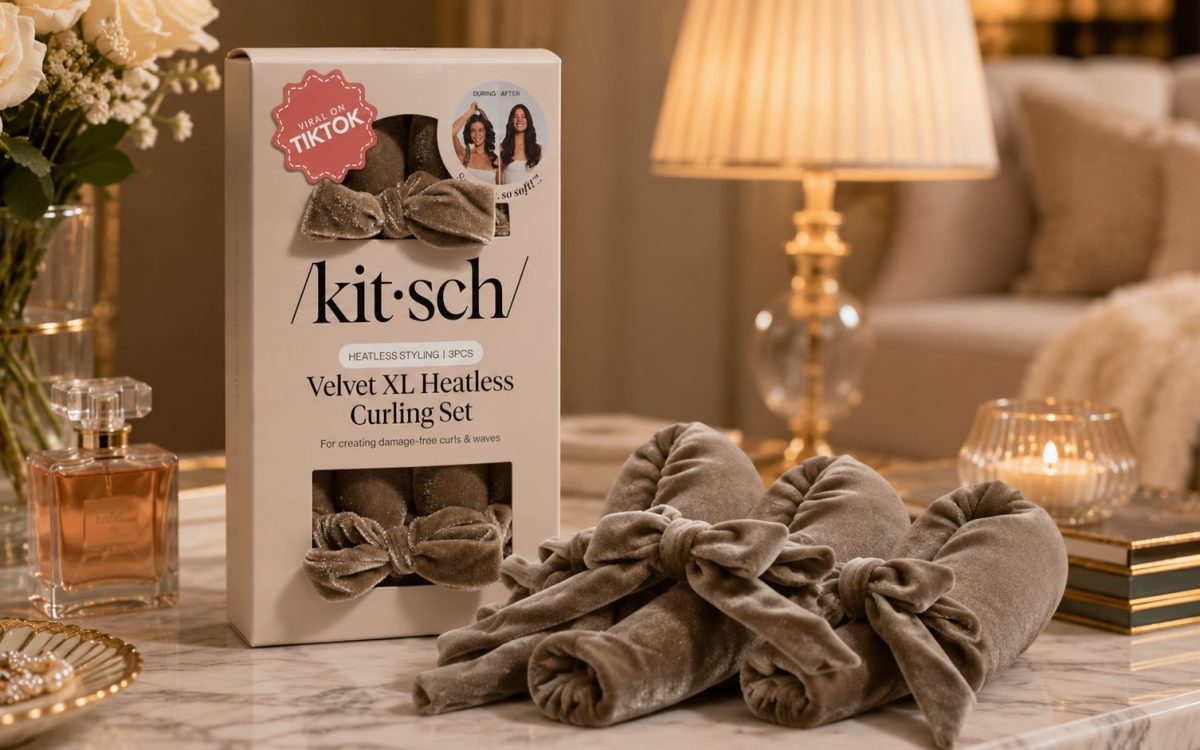
Heatless curling rods genuinely work, and they genuinely spare your hair the damage a curling iron does. They also fail for a lot of people, and the reasons are predictable enough that you can tell in advance whether you are one of them.
So here is the honest version of the Kitsch velvet heatless curling set — including a correction to the claim we made ourselves in the original version of this review.
A note on how we work: we have not used this particular set. What follows is based on its stated design and on how heatless curling works generally.
The One Detail That Decides Whether It Works
Almost every failed heatless curl comes down to moisture, and the rule is narrow:
Damp. Not wet, not dry.
Hair holds a curl because hydrogen bonds inside the strand re-form as it dries in a new shape. Dry hair has already set — there is nothing to reshape, so you wake up to a slight bend that drops within the hour. That is the most common reason people conclude these do not work.
Soaking wet hair is the opposite problem and a more serious one. It will not dry overnight inside a wrapped rod, so you wake with damp hair and no curl — and prolonged saturation causes hygral fatigue, where the hair shaft repeatedly swells and contracts and weakens over time. Sleeping in genuinely wet hair also keeps your scalp damp for hours, which is not good for it.
The target is roughly 80% dry — towel-dried and then air-dried or rough-blow-dried until it feels cool and barely damp, not cold and heavy. Get this right and the tool works. Get it wrong and no rod on the market will save you.
Velvet Versus Satin: A Trade, Not a Win
Our original review said velvet beats satin. That was too simple, and it is worth correcting because the difference matters depending on your hair.
Velvet grips. This is a real advantage and the reason it is popular. Satin and silk rods slide, and if you move a lot in your sleep or have fine, slippery hair, you will find a satin rod abandoned on the other side of the bed by morning. Velvet holds the wrap in place all night.
But grip is friction. The entire reason silk and satin are recommended for hair is that low friction prevents cuticle damage and breakage — it is the same principle behind silk pillowcases. A textured velvet surface holding your hair under tension for eight hours is, by definition, more friction than a smooth one.
So the honest position is a trade-off:
- Choose velvet if satin rods keep slipping out, or your hair is fine and silky and refuses to stay wrapped.
- Choose satin or silk if your hair is already fragile, dry, chemically treated or breakage-prone, or if you plan to do this most nights. Gentler surface, and slippage is less of an issue on coarser hair anyway.
Either way, heatless does not mean risk-free. You have removed heat damage, which is the big one. Tension and friction are still present, so wrap firmly rather than tightly.
Who This Doesn’t Work For
The listing says it suits all hair types and lengths. In practice it does not, and knowing which group you are in saves you the purchase:
- Short hair. You need enough length to wrap around the rod several times. Above the collarbone, results get patchy; a bob generally will not work at all. This is the hard limit.
- Very thick or coarse hair. The XL rod helps, but the real problem is drying time. If your hair takes hours to dry loose, it will not dry wrapped, and you will wake to damp hair and no curl. Workaround: start earlier in the evening, wrap in smaller sections, or accept using two rods.
- Very fine hair. Curls form easily but often drop within a couple of hours without setting spray or mousse.
- Light sleepers. There is a padded rod around your neck all night. Most people adjust within a few nights; some never do, and no amount of softness fixes that.
- Tightly coiled or type 4 hair. The technique is designed to loosen and lengthen rather than define an existing curl pattern, so results are often not what people expect.
Expect a Learning Curve
Worth saying plainly: your first attempt will probably look uneven, and most people need three or four goes before it is reliable. The usual culprits are hair that was too dry, sections wrapped at inconsistent tension, or ends left loose and kinked.
A few things that help: wrap away from your face on both sides so the curls frame rather than fall flat; keep the tension even from root to end; make sure the very tips are tucked properly, since a stray end kinks and shows; and in the morning separate the curls with your fingers rather than a brush.
What You Get
Three pieces: one extra-long flexible velvet-wrapped foam rod and two velvet bow scrunchies. The XL length is a genuine benefit for long or thick hair, where standard rods run out partway down. Wrap tighter for defined curls, looser for waves. The foam core means no dent and no pressure point, which matters when the technique requires sleeping on it.
Who It’s For
Buy it if your hair is at least shoulder length, dries at a reasonable pace, and you are willing to spend a few nights learning the technique — particularly if satin rods have slipped out on you before.
Skip it if your hair is short, takes half a day to dry, or is already fragile enough that eight hours of tension against a textured surface is a bad trade — in which case a silk or satin rod is the better buy even though it grips less well.
The core promise holds up: waves without a curling iron is a real saving for your hair. It just is not effortless, and it is not for everyone.
Prices and availability are accurate as of the date of publication and are subject to change. Please check the product page on Amazon for current pricing and other details.
Pair it with a silk pillowcase for the ultimate beauty sleep — both are in our list of luxury finds under $50.
Written by Milica Jovanović, founder of Feel Like A Goddess. I hunt down beautiful, well-made things that make everyday life feel a little more extraordinary, and I only recommend what I genuinely believe in.