
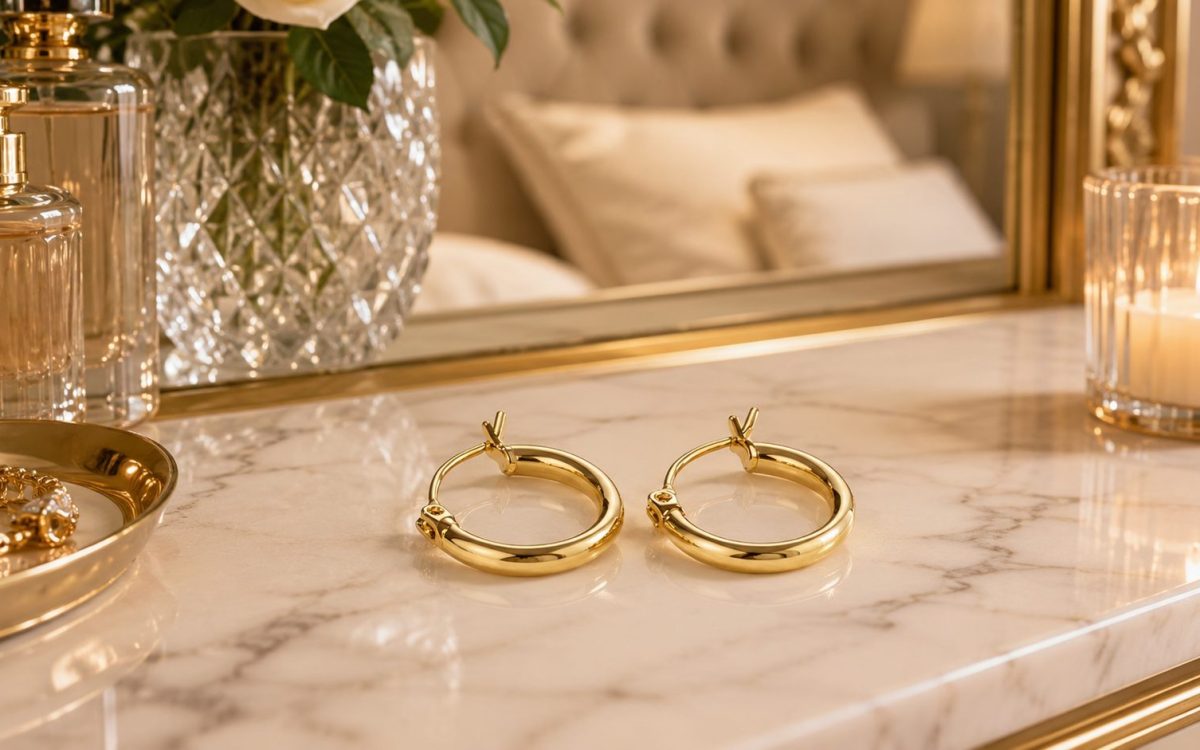
Somewhere in your city there’s a woman you’ve noticed — at a café, in a meeting, across a dinner table — who seems effortlessly put together. Look closer and she isn’t wearing much jewelry at all. A delicate chain, maybe a ring. And almost always, a small pair of gold hoops that seem to live on her ears.
Huggie hoops are the easiest version of that look to own. But “14k gold-plated” is one of the most misunderstood phrases in jewellery, and if you buy these expecting them to behave like gold, you will be disappointed in about eight months. So here is the straight version first.
A note on how we work: we have not worn this particular pair. What follows is based on the product’s stated specifications and on how gold-plated jewellery behaves generally — including the parts that are usually left out of the listing.
What “14k Gold-Plated” Actually Means
The “14k” describes the purity of the gold in the plating layer. It says nothing about how much gold is there — and that is the number that determines whether your earrings look good in two years.
Gold plating is a microscopically thin layer of gold electroplated onto a base metal, usually brass. Unlike gold vermeil, the term “gold-plated” has no legally required minimum thickness in the US. Plating can legally be as thin as 0.175 microns — a fraction of the width of a human hair. Most fashion pieces sit around 0.5 microns.
The practical translation: gold-plated jewellery typically lasts six months to two years with regular wear before the plating starts wearing through at friction points. Thinner flash-plating can show wear within weeks.
The tiers above it, so you know what you are choosing between:
- Gold vermeil — an FTC-regulated term: sterling silver base, at least 10k gold, minimum 2.5 microns. Five times the gold of standard plating. Lasts roughly two to five years, and when it does wear you still have real silver underneath rather than brass.
- Gold-filled — a much thicker gold layer bonded under heat and pressure. Lasts ten to thirty years. The genuine “buy once” option.
Two Claims Worth Correcting
“Hypoallergenic” does not hold for gold-plated brass. While the plating is intact, your skin only touches gold and most people are fine. But once it wears through at contact points, the brass beneath is exposed — and brass commonly contains nickel as a hardening agent. If you have a known nickel sensitivity, plated brass is not the right purchase, and no listing describing it as hypoallergenic changes that. Look for surgical steel or sterling silver as a base instead.
“Tarnish-resistant” is true only of the gold layer. Gold itself does not tarnish. The base metal underneath very much does, which is why plated pieces sometimes turn skin green or develop dark patches after months of wear. That is not a defective item; it is the plating doing what plating does.
Why They Can Still Be the Right Buy
None of the above makes them a bad purchase. It makes them a different purchase than the listing implies.
Priced under $50, gold-plated huggies are honestly priced for what they are: a year or so of looking like you own good jewellery, for the cost of a takeaway. That is a perfectly rational trade, and it is the right one if you are still working out whether you actually wear hoops daily, or if you like rotating styles rather than committing to one forever.
Where it stops being rational is above roughly $100. At that price you are paying vermeil money for plating durability, and you should simply buy the vermeil.
The design itself is genuinely the most wearable shape in earrings. Huggies sit close to the lobe, flatter essentially every face shape, read polished at work and easy at the weekend, and stack well if you have a second piercing. That part of the appeal is real.
Choosing Your Size
14 mm is the true huggie — snug and subtle. 16 mm has enough presence to stand alone as your only accessory. 18 mm reads as a deliberate statement. If you are stacking with a second piercing, the smaller sizes layer better.
How to Make Them Last Twice as Long
Plating wears from friction, moisture and chemistry. All three are manageable:
- Take them out to shower, swim and exercise. Soap residue and sweat are the two fastest ways to strip plating.
- Perfume and hairspray go on first, earrings second. Alcohol in both attacks the finish directly.
- Do not sleep in them. Attractive as the idea is, eight hours of nightly friction against a pillow is exactly what wears the plating through at the clasp.
- Wipe with a soft dry cloth and store dry, ideally in a pouch rather than loose in a dish.
Who Should Buy, and Who Shouldn’t
Buy them if you want the everyday-gold look at a low entry price, you are happy treating them as a piece to replace in a year or two, and you have no nickel sensitivity.
Skip them if you react to costume jewellery, you want something you genuinely never take off including in the shower, or you are shopping for a keepsake gift — a christening, an anniversary, a milestone. For those, gold-filled or vermeil is the honest recommendation even though it costs more.
Everyday gold is a lovely habit. Just buy it knowing which version you are holding.
Prices and availability are accurate as of the date of publication and are subject to change. Please check the product page on Amazon for current pricing and other details.
Want more pieces that look far more expensive than they are? See our full list of luxury finds under $50.
Written by Milica Jovanović, founder of Feel Like A Goddess. I hunt down beautiful, well-made things that make everyday life feel a little more extraordinary, and I only recommend what I genuinely believe in.